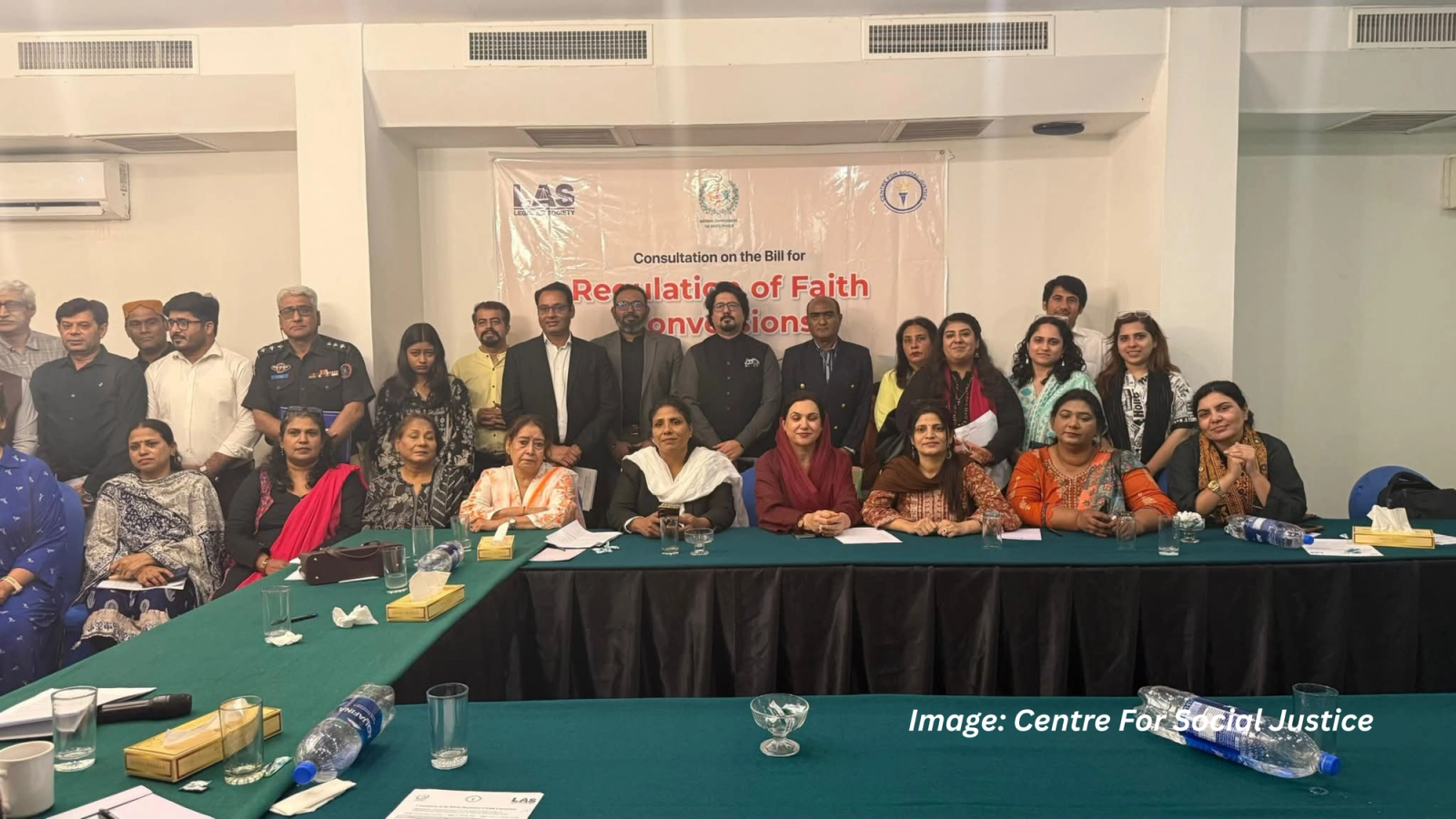
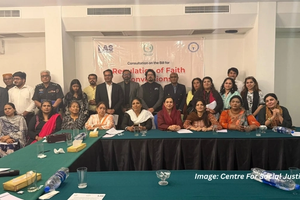
A recent policy consultation in Pakistan has brought renewed attention to the sensitive and often controversial issue of faith conversions, particularly involving minors from minority communities. The session, organized by the Centre for Social Justice (CSJ) in collaboration with the National Commission on the Rights of Child (NCRC) Pakistan and the Legal Aid Society, focused on the proposed draft of the Regulation of Faith Conversions Bill and the urgent need for legal protections.
The consultation gathered a wide range of stakeholders, including lawmakers, legal experts, civil society representatives, and human rights advocates. Participants engaged in detailed discussions around the current legal gaps surrounding religious conversions and the risks these gaps pose, especially for vulnerable groups such as minority children.
A central concern raised during the session was the increasing number of reported cases involving minors who are allegedly coerced or manipulated into changing their religion. Experts emphasized that without a clear legal framework, it becomes difficult to distinguish between voluntary conversions and those carried out under pressure or exploitation. This ambiguity, they argued, not only undermines justice but also exposes minority communities to systemic vulnerability.
Speakers at the consultation stressed that the proposed bill aims not to restrict religious freedom, but to regulate the process in a way that ensures transparency, consent, and protection, particularly for minors. Legal analysts pointed out that in its current form, Pakistan’s legal system lacks specific mechanisms to verify the age, consent, and circumstances surrounding a person’s conversion, leaving room for misuse.
The issue is further complicated by the intersection of religion, culture, and law. In many cases, conversions are closely tied to social dynamics, including marriage, economic pressure, and community influence. This makes it challenging for authorities to intervene effectively without a structured legal process. Participants noted that a well-defined regulatory framework could help balance the right to religious freedom with the need to protect individuals from coercion.
Child protection emerged as a key theme throughout the consultation. Representatives from child rights organizations highlighted that minors, by definition, may not possess the legal or emotional capacity to make life-altering decisions such as religious conversion. As a result, there is a growing call for legislation that introduces age restrictions, mandatory verification procedures, and judicial oversight in cases involving minors.
Human rights advocates also raised concerns about the broader implications of unregulated conversions on social harmony and minority rights. They argued that when such cases are perceived as forced or unjust, they can deepen mistrust between communities and contribute to instability. Ensuring fairness and accountability in these matters, therefore, is not only a legal necessity but also a social imperative.
Another important dimension discussed was Pakistan’s constitutional commitment to freedom of religion. Participants acknowledged that any legislation must carefully navigate this principle, ensuring that it does not infringe upon an individual’s right to choose their faith. However, they also emphasized that freedom must be accompanied by safeguards, especially when there is a risk of abuse or coercion.
The consultation concluded with a strong consensus on the need for immediate legislative and policy action. Stakeholders urged the government to prioritize the adoption of a comprehensive legal framework that addresses the complexities of faith conversions while upholding both human rights and constitutional values.
While the proposed Regulation of Faith Conversions Bill is still under discussion, the outcomes of this consultation signal a growing recognition of the issue at both legal and societal levels. As debates continue, the challenge for policymakers will be to craft a law that is both protective and balanced, one that safeguards the vulnerable without compromising fundamental freedoms.
In a country where religion plays a central role in public and private life, the way this issue is addressed will likely have lasting implications, not only for minority communities but for the broader principle of justice itself.
News | Pakistan
Consultation Highlights Urgent Need for Legal Safeguards on Faith Conversions in Pakistan
A policy consultation in Pakistan highlights urgent legal gaps in faith conversion laws, with experts calling for safeguards to protect minors and ensure religious freedom.
Comments
Sign in to comment and follow the conversation.
Sign in to commentMore From News
Most Popular

Christian Persecution Explained: Where Faith Becomes Dangerous

Buckingham Palace Skips Easter Message as Debate Grows Over Royal Religious Signals
Punjab Minority Rights Bill 2026 Introduced Amid Debate Over Interfaith Marriage in Pakistan
Rising Threats in Northern Nigeria Put Christians at Risk Ahead of Easter
Opinion: Faith Under Fire, What War Means for Christians in Iran
Consultation Highlights Urgent Need for Legal Safeguards on Faith Conversions in Pakistan
Trending
Christian Persecution Explained: Where Faith Becomes Dangerous
Buckingham Palace Skips Easter Message as Debate Grows Over Royal Religious Signals
Punjab Minority Rights Bill 2026 Introduced Amid Debate Over Interfaith Marriage in Pakistan
Rising Threats in Northern Nigeria Put Christians at Risk Ahead of Easter
Opinion: Faith Under Fire, What War Means for Christians in Iran
Loading comments...